Skip to searchSkip to main content
hs-tumbler_en
    Languages
    Trajectory Mixing for Refractory Specialty Formulations | HS-Tumbler

    Trajectory Mixing for High-Performance Castables and Specialty Formulations

    Scientifically validated technology for quality-critical applications. Research conducted at Koblenz University of Applied Sciences demonstrates that cold modulus of rupture reaches its maximum at precisely 90 seconds mixing time. Zero percent metal abrasion contamination, 95 percent less wear, and reproducible quality with coefficient of variation below five percent. With a throughput of 2.2 tons per hour, the system combines highest quality with industrial productivity.

    International FoodTec Award Gold 2024
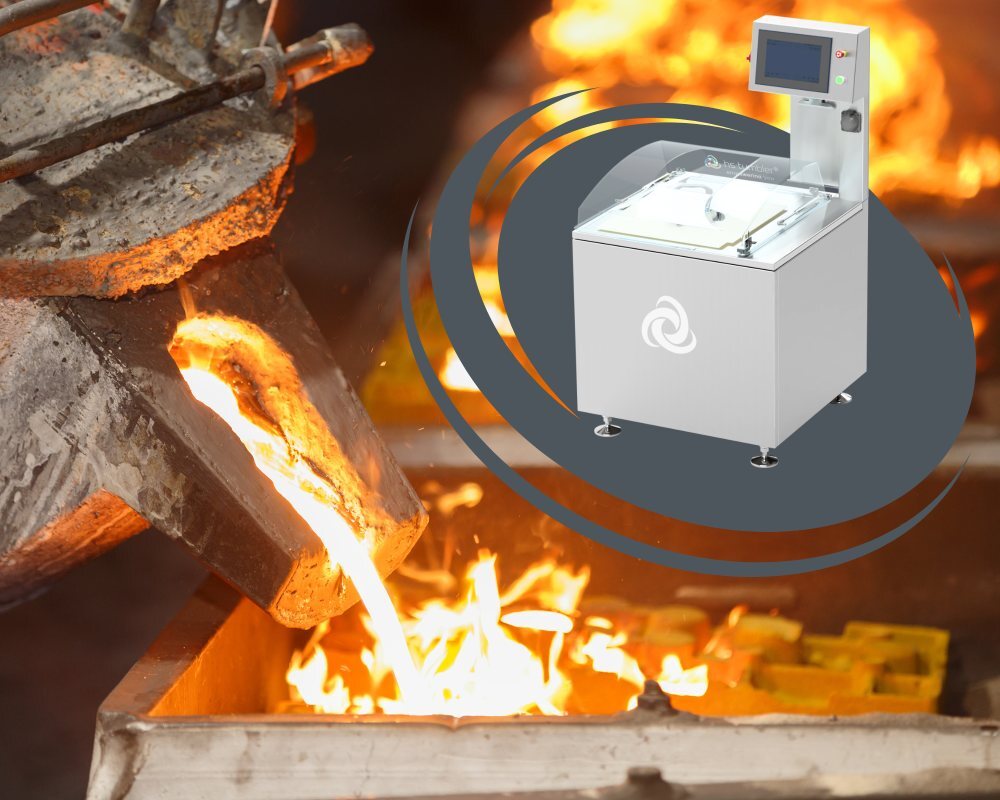
    J4 Trajectory Mixer – Automated production unit for scientifically validated specialty production

    Applications Where Trajectory Mixing Excels

    Trajectory Mixing addresses the fundamental quality challenges in specialty formulation production. The technology is ideally suited for manufacturers where batch quality, contamination-free processing, and flexible small series production are paramount. The modular architecture enables scaling from laboratory quantities to industrial volumes.

    High-Performance Castables

    Scientific research demonstrates that cold modulus of rupture reaches its maximum at 90 seconds mixing time. Homogeneous distribution with coefficient of variation below five percent leads to more uniform mechanical properties and measurably extended service life. Particularly valuable for critical applications with stringent quality requirements in the steel industry. Zero percent metal abrasion contamination guarantees chemical purity without compromise.

    Temperature-Sensitive Formulations

    Ideal solution for modern PCE-based castables. Research results with silicon carbide and polycarboxylate ether demonstrate that temperature increase remains minimal while fluidity is optimally preserved. Controlled temperatures between 18 and 25 degrees Celsius prevent thermal desorption of dispersing agents and completely eliminate flash-setting risks. Gentle mixing preserves the full effectiveness of temperature-sensitive additives.

    Research and Development

    Excellent for systematic formulation development and materials research. Reproducible results through mathematically defined Lissajous trajectories enable precise experimental series. Rapid product changeover with 70-second container exchange time maximizes efficiency in new formulation optimization. Small batch sizes starting at 15 kilograms reduce material consumption during development phases. Scientific validation at Koblenz University of Applied Sciences confirms the technology's precision.

    Pharmaceutical and Food-Grade Production

    International FoodTec Award Gold 2024 confirms suitability for highest purity requirements. Zero percent metal abrasion contamination meets GMP standards without compromise and eliminates the risk of costly product recalls due to foreign particles. Documentable purity and reproducibility meet the strictest requirements of regulated industries. Validatable processes for pharmaceutical environments guarantee batch-to-batch consistency.

    Specialty Production with Frequent Changeovers

    Perfect solution for manufacturers with diversified product portfolios. The four-container system enables 90 batches per hour at a throughput of 2.2 tons. Exchange of all four containers occurs in only 70 seconds, supporting flexible production changeovers without significant time loss. Minimal cross-contamination through simple container cleaning outside the machine. Ideal for custom formulations and small lot sizes with highest quality requirements.

    Battery Electrodes and Technical Ceramics

    Gentle mixing without particle damage preserves the integrity of active materials. Homogeneous electrode mass slurries measurably improve cycle stability and electrochemical properties. For technical ceramics, precise binder distribution enables uniform densification and superior sintering results. Contamination-free processing is critical for high-tech ceramics in electronics and medical technology.

    90sOptimal mixing time (scientifically validated)
    70sContainer exchange time (all 4 containers)
    90Batches per hour
    2.2tThroughput per hour
    <5%Coefficient of variation
    0%Metal abrasion contamination

    Scientifically Validated Through Research at Koblenz University of Applied Sciences

    The superiority of Trajectory Mixing for refractory castables has been scientifically demonstrated through systematic research at Koblenz University of Applied Sciences. The results clearly show that conventional mixing techniques represent the critical first phase in castable production, directly influencing material properties.

    Validated Research Results for Silicon Carbide with Polycarboxylate Ether

    Test series with highly abrasive silicon carbide formulations and modern PCE dispersing agents document the technology's performance under realistic production conditions. Cold modulus of rupture reaches its maximum precisely at 90 seconds mixing time, defining the optimal balance between homogeneity and processing time. Fluidity remains stable throughout the entire mixing process, without the degradation typical of conventional high-shear mixers. Particularly noteworthy is the minimal temperature increase, which prevents thermal desorption of temperature-sensitive PCE molecules and preserves full dispersing effectiveness. Mechanical strength significantly exceeds conventionally mixed comparison samples, confirming the superior homogeneity of Lissajous-based mixing.

    Measurable Quality Advantages

    Research data demonstrates quantifiable improvements over conventional methods. The coefficient of variation consistently remains below five percent, while traditional paddle mixers typically achieve values between eight and twelve percent. This superior homogeneity manifests as more uniform distribution of aggregates and additives, minimizing local weak points and measurably extending service life. Reproducible mixing conditions through mathematically defined trajectories guarantee batch-to-batch consistency unattainable with manually controlled systems.

    Temperature Control as Quality Factor

    Research results demonstrate the direct relationship between temperature control and product quality. While conventional high-shear mixers generate temperatures above 32 degrees Celsius through intensive mechanical processing, Trajectory Mixing remains in the optimal range between 18 and 25 degrees Celsius. This is particularly critical for modern PCE-based formulations, where thermal desorption drastically reduces dispersing effectiveness and can lead to premature setting. Controlled temperature extends processing time and improves fluidity during casting.

    Technical Specifications and Production Throughputs

    HS-Tumbler Trajectory Mixing systems cover a broad spectrum from laboratory applications to industrial specialty production. External container handling enables parallel filling and emptying during the mixing process, maximizing productivity. Larger container variants in development continuously expand the application spectrum.

    K1 Trajectory Mixer – Laboratory mixer for development and small series

    K1 Laboratory and Development System

    Excellent for formulation development, materials research, and small production batches. With a volume of 0.75 to 4.5 liters and a processing capacity of up to 10 kilograms of process material, the K1 enables precise trials with industrially relevant quantities in a compact form. This high capacity is particularly valuable for specialty ceramics manufacturers processing high-density powder mixtures. The compact design fits any laboratory, while Trajectory technology guarantees the same mixing quality as industrial systems. Scientific validation at Koblenz University of Applied Sciences was conducted with this system, demonstrating precision and reproducibility even with smallest batches. The ability to process significant material quantities despite small volume significantly reduces the number of required batches during development phases and accelerates product development. Optional thermal extension for temperature control up to 150 degrees Celsius and vacuum generator further expand application possibilities.

    • Volume: 0.75 to 4.5 liters useful volume
    • Processing capacity: Up to 10 kilograms process material
    • Particularly suitable for specialty ceramics manufacturers with high material densities
    • Application range: Laboratory, development, micro series with industrial relevance
    • Scientifically validated for reproducible results
    • Optional thermal extension for temperature control up to 150 degrees Celsius
    • Vacuum generator integrable for degassing applications
    J4 Trajectory Mixer – Automated production unit

    J4 Automated Production Unit

    Excellent for industrial specialty production with highest quality requirements. The system operates with four containers mixing simultaneously. Process containers are filled and emptied externally while undergoing the 90-second mixing process in the machine. After 90 seconds, all four containers are exchanged together in only 70 seconds. This intelligent logistics enables 22.5 cycles per hour, which with four containers equals 90 batches per hour. With 14.5 liters useful volume per container and typical ceramic density of 1.7 kilograms per liter, the system achieves a throughput of 2.2 tons per hour. The automated design reduces operator errors and guarantees reproducible quality across all batches.

    • Four containers with 17 liters gross each, 14.5 liters useful volume
    • Mixing time: 90 seconds (scientifically optimized for CMoR maximum)
    • Container exchange: 70 seconds for all four containers together
    • Throughput: 2.2 tons per hour (90 batches at 24.65 kilograms each)
    • Annual production: approximately 4,400 tons (8 hours daily, 250 days)
    • Advantage: External filling and emptying parallel to mixing process
    • Application range: Quality-oriented specialty production with industrial volumes

    Intelligent Four-Container Logistics Maximizes Productivity

    The J4 system utilizes a sophisticated four-container concept combining highest quality with industrial productivity. All four containers mix simultaneously during the scientifically optimized 90 seconds. After completion of the mixing process, all four containers are exchanged together in only 70 seconds. This results in a total cycle of 160 seconds, enabling 22.5 cycles per hour. Since each cycle completes four containers, the system achieves 90 batches per hour. External filling and emptying occurs completely parallel to the mixing process, eliminating wait times. With 14.5 liters useful volume per container and typical material density of 1.7 kilograms per liter, batch size is 24.65 kilograms, resulting in a throughput of 2.2 tons at 90 batches per hour. This logistics makes the system particularly efficient for applications requiring highest quality standards with industrial production volumes.

    Scaling for Growing Requirements: Larger Containers in Development

    The modular system concept enables continuous scaling for growing production volumes. We are currently developing larger container variants guaranteeing the same quality level at higher throughputs. The next planned size is containers with 70 liters useful volume, which at the same cycle time of 160 seconds and four containers would enable an estimated throughput of approximately 8.5 tons per hour. This is followed by containers with 250 liters useful volume, potentially achieving an estimated throughput of approximately 30 tons per hour. These developments demonstrate the technology's scalability for growing production requirements. The same scientifically validated mixing principles guarantee superior quality and reproducibility even at larger volumes. Contact us directly for current information on development status.

    Quality Challenges in Refractory Production

    Mixing is the critical first step in castable production. The quality of this phase directly influences refractory material quality and mechanical properties. Studies show that 20 to 30 percent of all premature failures are attributable to insufficient mixing quality. Conventional methods struggle with systematic challenges affecting consistency and economic efficiency.

    Extreme Tool Wear

    Highly abrasive components such as aluminum oxide and silicon carbide cause extreme wear on mixing tools, paddles, and seals. Hard particles attack all mechanical components in contact with the material. Mixing blades typically require replacement every six to twelve months, causing not only material costs but also significant downtime. For specialty formulations with particularly hard aggregates, this cycle shortens further. Unplanned failures due to wear damage impair production planning and significantly increase operating costs.

    Contamination Through Metal Abrasion

    Mixing blade wear inevitably leads to metal abrasion in the product. For high-performance castables and regulated applications, this is critical. Metal particles can create local weak points and compromise chemical purity, particularly problematic in critical steel industry applications. In pharmaceutical and food-grade applications, metal abrasion is unacceptable and can lead to costly product recalls. Contamination is unavoidable in conventional systems with mechanical mixing tools and worsens with increasing tool wear.

    Uncontrolled Frictional Heat

    Research results demonstrate that temperatures above 32 degrees Celsius risk premature setting. Modern PCE dispersing agents lose effectiveness through thermal desorption, potentially leading to flash setting. High-shear mixers generate significant temperature increases during mixing through intensive mechanical processing. Controlling this heat development is critical for processing time and final product quality. For temperature-sensitive specialty formulations with PCE-based systems, this is particularly problematic, leading to reduced fluidity and shortened processing times.

    The Measurable Costs of Inferior Quality

    Insufficient mixing quality manifests as uneven distribution of aggregates and additives, leading to local weak points and microcracks. The result is performance loss up to 25 percent and significantly shortened service life. The coefficient of variation should be below five percent for optimal results, yet many conventional systems achieve only values between eight and twelve percent. This inhomogeneity later manifests as uneven wear patterns in linings and leads to unplanned shutdowns, whose costs often exceed material costs many times over. Scientific research at Koblenz University of Applied Sciences quantitatively documents these relationships and demonstrates direct effects on mechanical strength.

    The Solution: HS-Tumbler Trajectory Mixing

    The Fundamental Principle

    Conventional mixers with mixing tools reach only a small portion of the process mass per revolution. Even powerful systems with multiple mixing tools manipulate only a fraction of the material at any moment. The Trajectory Mixer, in contrast, always manipulates 100 percent of the material simultaneously. The entire mixing container follows complex three-dimensional movement patterns without requiring mechanical mixing tools working in the material. This fundamental principle completely eliminates wear, contamination, and uncontrolled frictional heat.

    K1 – Comparison graphic conventional mixing technology vs. Trajectory Mixing

    Comparison: Conventional mixing technology vs. Trajectory Mixing

    Lissajous Trajectories for Reproducible Quality

    Two independent motion axes generate high-frequency, precise patterns for simultaneous mixing of the entire batch. These Lissajous trajectories are mathematically defined curves resulting from the superposition of two sinusoidal oscillations. The result is uniform, reproducible mixing without dead zones. Each particle traverses a defined path during the 90-second mixing cycle, guaranteeing optimal homogeneity. The broad range of possible trajectories enables adaptation to different materials and viscosities without requiring mechanical system modifications.

    Transparency on Wear Behavior

    The cylindrical process container experiences wear on the inner wall through material contact. This is physically unavoidable when abrasive materials are moved. The decisive difference lies in maintenance intensity and predictability. The container can be manufactured from wear-resistant material or coated and typically lasts several years without replacement. While mixing tools must be replaced every six to twelve months and their failure causes unplanned downtime, maintenance for the Trajectory Mixer is limited to scheduled inspections. Maintenance costs thereby reduce by approximately 60 to 80 percent, while production planning improves significantly through avoidance of unplanned failures.

    Scientifically Validated Advantages

    • 90 seconds optimal mixing time, validated through research at Koblenz University of Applied Sciences with maximum cold modulus of rupture
    • Four-container system enables 90 batches per hour at 2.2 tons throughput, as filling and emptying occur parallel to mixing process
    • Approximately 95 percent less wear through complete elimination of mechanical mixing tools in material
    • Zero percent metal abrasion contamination guarantees chemical purity for critical high-performance applications
    • Controlled temperature between 18 and 25 degrees Celsius protects PCE dispersing agents from thermal desorption
    • Coefficient of variation below five percent for superior homogeneity and reproducible quality
    • Minimal temperature increase preserves fluidity and measurably extends processing times
    • 70 seconds container exchange time for all four containers together enables flexible production changeovers

    Economic Assessment for Your Specific Application

    The economic viability of Trajectory Mixing depends on your individual production parameters. Factors such as material composition, production volume, maintenance intervals of conventional systems, local energy costs, and quality requirements influence payback period. With realistic throughput of 2.2 tons per hour for the J4 system and planned larger containers, the system grows with your requirements.

    Primary Cost Savings

    Economic advantages result from several measurable factors. Maintenance and wear costs reduce by 60 to 80 percent through elimination of mechanical mixing tools and scheduled rather than unplanned maintenance. Energy savings through optimized movement patterns and scientifically validated 90-second cycle time contribute to lower operating costs. Quality improvements through coefficient of variation below five percent measurably reduce scrap and complaints. Avoidance of unplanned downtime through wear failures significantly increases planning reliability. Particularly valuable is contamination-free processing for regulated applications where product recalls are avoided. The ability to produce 90 batches per hour at 2.2 tons throughput through the intelligent four-container system maximizes machine utilization and significantly reduces production costs per kilogram.

    Individual Payback Calculation

    We develop together with you a detailed economic analysis considering your specific operating parameters. This analysis includes your current maintenance costs and wear cycles, energy consumption and local energy prices, production volumes and batch sizes, quality costs through scrap and complaints, and downtime costs from unplanned failures. Based on this, we calculate realistic payback period and return on investment for your application. This comprehensive analysis enables a sound investment decision with realistic expectations.

    Schedule a Complimentary Economic Analysis

    We analyze your production environment together and calculate the specific savings potential for your application. This analysis is non-binding and provides you with a realistic assessment of economic advantages for your specific requirements. Contact us to schedule an appointment.

    Request Economic Analysis

    Direct Comparison: Conventional versus Trajectory Mixing

    The following comparison points are based on scientifically demonstrated advantages from research projects at Koblenz University of Applied Sciences and industrial validation in production environments.

    Conventional Mixers

    Wear and Maintenance

    High wear on mixing tools, paddles, seals. Replacement every six to twelve months required. Unplanned failures through wear damage significantly impair production planning.

    Contamination

    Unavoidable metal abrasion from mixing blades contaminates product. Critical for high-performance castables, pharmaceutical, and food-grade applications. Worsens with increasing tool wear.

    Temperature

    Uncontrolled frictional heat, often above 30 degrees Celsius. Flash-setting risk with temperature-sensitive formulations using PCE dispersing agents. Reduced fluidity and shortened processing times.

    Homogeneity

    Coefficient of variation typically eight to twelve percent. Uneven distribution leads to local weak points and shortened service life. Reproducibility suffers from operator variability.

    Product Changeover

    Extensive cleaning required for product changeover. Cross-contamination possible. Long setup times significantly reduce flexibility for diversified product portfolios.

    Throughput Limitation

    Filling and emptying completely block the machine. Dead times significantly reduce effective throughput. Inefficient machine utilization increases production costs per kilogram.

    Trajectory Mixing

    Wear and Maintenance

    Approximately 95 percent reduction through elimination of mixing tools in material. Container service life of several years. Scheduled maintenance instead of unplanned failures significantly improves production planning.

    Contamination

    Zero percent metal abrasion contamination guaranteed. 100 percent product purity for high-performance applications. Ideal for regulated industries and critical quality requirements.

    Temperature

    Scientifically validated: Controlled 18 to 25 degrees Celsius. Optimal PCE effectiveness without thermal desorption. No flash-setting. Extended processing times and improved fluidity.

    Homogeneity

    Research result: Coefficient of variation below five percent. 100 percent of material simultaneously mixed. No dead zones. Reproducible quality through mathematically defined trajectories.

    Product Changeover

    70 seconds container exchange time for all four containers together. Minimal cross-contamination through external cleaning. High flexibility for small series and diversified product portfolios.

    Maximum Productivity

    External filling and emptying parallel to mixing process. Four-container system enables 90 batches per hour at 2.2 tons throughput. Optimal machine utilization without dead times.

    Is Trajectory Mixing the Right Solution for Your Application?

    Trajectory Mixing is ideally suited for quality-critical applications with purity requirements, temperature-sensitive formulations, or frequent product changeovers. The scientifically validated technology guarantees reproducible quality with coefficient of variation below five percent and zero percent metal abrasion contamination. With current throughput of 2.2 tons per hour and larger containers in development, the system grows with your requirements. We are pleased to analyze your specific situation and demonstrate concrete advantages for your production parameters. Schedule a non-binding consultation to discuss scientifically validated advantages for your application.