
Friction materials
Mixing friction materials without a stirrer
Friction material formulations are mixed in the trajectory mixer without a rotor or stirrer running through the batch. Reinforcing fibres are dispersed by the movement of the whole mass, so no tool cuts through them.
The hs-tumbler trajectory mixer is a universal mixer with no stirrer and no moving parts in the vessel, for powders, pastes, slurries, fibres and lumpy foods such as meat. The vessel is exchanged instead of cleaned. This makes it economical for individual production with small batches and frequent recipe changes.
Friction materials are one of the areas we are currently working on. That is why we test with your formulation and document the result.
Starting point
Why a rotating tool costs fibre length
In a mixer with a rotating tool, the tool moves through the batch. Aramid, glass and mineral fibres pass between tool and wall, and part of them is cut. Fibre length carries the mechanical strength of the finished lining, so what the mixer cuts is lost for the product.
In the trajectory mixer the process vessel moves along a trajectory: a programmable Lissajous curve in a plane that can be changed during the process. You can try the trajectory curve interactively. Shear forces arise from adhesion and inertia, along the vessel wall and within the material itself, not from friction against a tool. There are no moving parts in the vessel, no stirrer and no rotating drum.
Fibre dispersion
The whole mass is in motion, so there are no dead zones at the wall or around a shaft. Fibre bundles are separated and distributed without the fibres being shortened or cut. Dense components such as metal powders and mineral fillers are distributed in the same step.
Temperature during mixing
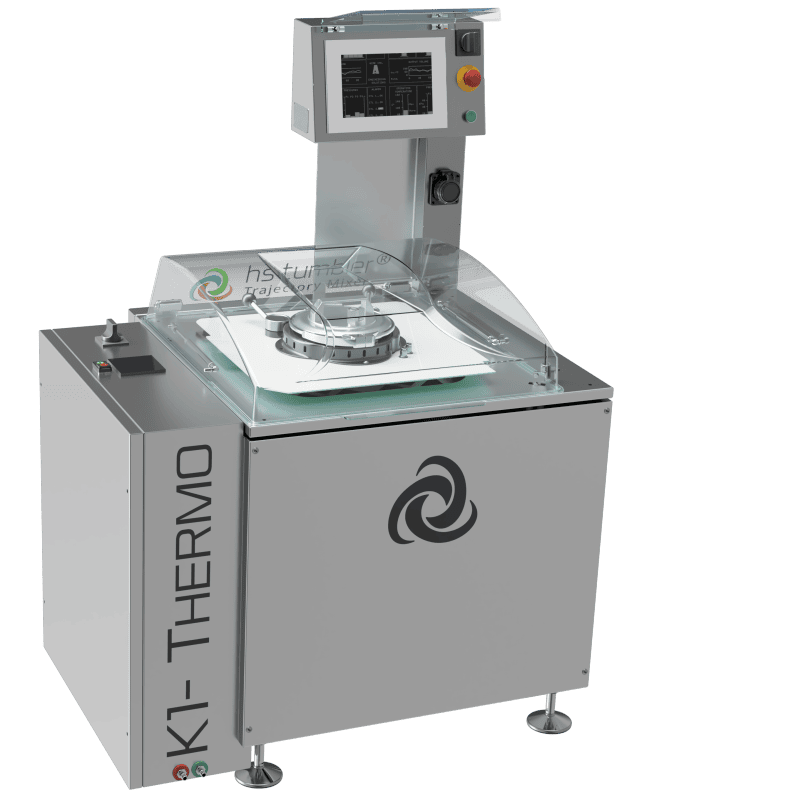
Phenolic binders cure at elevated temperature, and rubber components can scorch. Without a tool rubbing in the material, there is no local friction heat at a tool. How much a batch warms up depends on the material, its viscosity and the mixing time, so it has to be determined for each formulation in a trial. In our work we see markedly less heating than with mixers that have a rotating tool; we do not yet have a systematic study that quantifies the difference. On the K1-Thermo the vessel is temperature-controlled while it is mixed.
Batch-to-batch consistency
A replacement lining may deviate from the friction characteristics of the original part by no more than 15 % under ECE Regulation 90. That tolerance has to come out of the formulation and the process. The movement pattern of the trajectory mixer is set in the recipe and repeated run after run, and it stays geometrically the same from the K1 in the laboratory to the J4 in production.
From batch to batch-continuous
Short process times change how a batch process runs. Vessels are filled, mixed and exchanged in a steady rhythm, so friction material production gains the advantages of flow production. Throughput follows from process volume, process time and cycle rate, which is why comparatively small vessels can still reach higher tonnages.
| Mixer with a rotating tool | Trajectory mixer | |
|---|---|---|
| Tool in the batch | A rotor or stirrer moves through the mix | None. The vessel moves along a trajectory |
| Reinforcing fibres | Fibres passing between tool and wall are partly cut | Neither shortened nor cut |
| Heating | Local friction heat at the tool | Markedly less; determined per formulation in a trial |
| Abrasive formulations | The mix wears against the tool | No tool, shaft seal or gearbox in contact with the product |
| Formulation change | Tool and vessel are cleaned | The vessel is exchanged instead of cleaned |
Technical data
Key data
| Viscosity range | From free-flowing powders, emulsions and whipped cream through honey-like and paste-like products up to kneadable masses about as stiff as pasta dough |
|---|---|
| K1 and K1-Thermo | Standard vessel volume about 4.5 litres, filled to about 85 % at most. The minimum fill depends on the material: sticky, highly viscous products need more, powders can go well below 500 grams. |
| J4-Base | 3 to 15 litres per process vessel, 4 × 15 litres = 60 litres per run |
| Fill weight | Up to 10 kg of product per K1 vessel, which matters for metal-filled and mineral-filled formulations denser than water |
| Vacuum | Available on every system |
| Temperature control | K1-Thermo: heating and cooling circuit from about −20 °C to over 100 °C depending on the heat transfer medium, or electric heating up to 150 °C |
| Plastic vessels | Where cleaning is not worthwhile: 4 litres gross on the K1, 16 litres gross on the J4 |
A good fit when …
- reinforcing fibres have to keep their length
- formulations change often, for example in development, small series and aftermarket variants
- dense or abrasive components tend to segregate
- the batch has to stay below a temperature limit
- a formulation is developed on a laboratory machine and later produced on the same movement pattern
- production is to run in a steady rhythm of small batches instead of one large batch at a time
Less suitable when …
- the material is stiffer than a kneadable dough, or has to be plasticised under pressure and heat
- the process needs a tool that cuts or grinds the fibres on purpose
Machines
From the laboratory to production

FAQ
Frequently asked questions
How does a trajectory mixer disperse aramid fibres without breaking them?
No tool moves through the batch. The process vessel travels along a programmable Lissajous curve in a plane and the whole mass moves with it, so shear forces arise from adhesion and inertia, along the vessel wall and within the material itself. Fibre bundles are pulled apart and distributed, and the fibres are neither shortened nor cut. In a mixer with a rotating tool, by contrast, fibres pass between tool and wall, and that is where fibre length is lost.
Which viscosities can the trajectory mixer handle?
At the thin end we make emulsions and whip cream, without significant heating. At the stiff end we work with kneadable masses about as stiff as pasta dough and have mixed modelling clay homogeneously. Materials that have to be plasticised under pressure and heat are beyond that range. Where the limit lies for your formulation, we find out in a trial.
Which friction material formulations can be mixed?
NAO formulations with aramid, glass and mineral fibres, semi-metallic formulations with a high metal content, and phenolic-bonded compounds with rubber, graphite and fillers. We have not run every one of these, so we test with your formulation before anyone makes a claim about it.
How does mixing help with ECE R90 approval?
ECE Regulation 90 allows a replacement lining to deviate from the friction characteristics of the original part by no more than 15 %. The mixer cannot deliver that approval, but it is one of the sources of scatter. The movement pattern is part of the stored recipe and is repeated run after run, which is what makes batches comparable.
How much does the mix heat up during mixing?
Heating is specific to the material and depends on its viscosity and the mixing time, so it is determined in a trial with your formulation. In our work we see markedly less heating than with mixers that have a rotating tool. We do not yet have a systematic study that quantifies the difference, so we do not quote a figure.
Can the mixer handle abrasive and metal-filled formulations?
Yes. There is no stirrer, no shaft seal and no gearbox in contact with the product, so there is no tool wearing against the mix. A K1 vessel takes up to 10 kg of product, which covers formulations well above the density of water. Scale-up from the K1 to the J4 has worked in several customer trials, abrasive materials included.
Which machines are available, and how does scale-up work?
The K1 and the K1-Thermo are for formulation development, samples and small batches, with a standard vessel volume of about 4.5 litres. The J4-Base runs four process vessels, 3 to 15 litres each and up to 60 litres per run, and it can be automated. The path the vessel travels is geometrically the same on both machines for a given product, so a recipe validated in the laboratory is transferred rather than redeveloped.
How does a trial with my own formulation work?
Send us your formulation. We mix it in the hs-tumbler technical centre in Quakenbrück, record the temperature during mixing and show you the result, including fibre distribution and homogeneity. If it does not work for your material, we tell you. We offer the trial in our technical centre. In return, we would like to report on it, subject to your agreement.
Further reading: Trajectory mixing explained · Features and benefits · Fibre composites · Products K1 and J4
Test it with your formulation
Send us your friction material formulation or arrange a consultation. We mix it in our technical centre and show you what comes out. We offer the trial in our technical centre. In return, we would like to report on it, subject to your agreement.