
Potting compounds
Mixing potting compounds without a stirrer
Thixotropic and filled two-component potting compounds can be homogenised and degassed under vacuum in the trajectory mixer, without a stirrer bringing friction heat into the resin.
The hs-tumbler trajectory mixer is a universal mixer with no stirrer and no moving parts in the vessel, for powders, pastes, slurries, fibres and lumpy foods such as meat. The vessel is exchanged instead of cleaned. This makes it economical for individual production with small batches and frequent recipe changes.
We are still building our experience with potting compounds. That is why we test with your material and document the result.
Starting point
Why mixing shortens pot life
A stirrer shears the resin locally at the tool. The friction heats the compound, and the heat speeds up the exothermic reaction of resin and hardener. Viscosity rises sooner and the usable pot life gets shorter.
Thixotropic and filled compounds
Thixotropic compounds thin under shear and thicken again at rest. In the trajectory mixer the whole mass moves along a programmed path, so it is sheared evenly throughout, not just next to a stirrer. Fillers are distributed without dead zones at the wall or around a shaft.
Degassing under vacuum
No stirrer reaches into the vessel, so there is no shaft feed-through to seal. Vacuum is easy to apply, for example to remove air before potting.
Temperature control
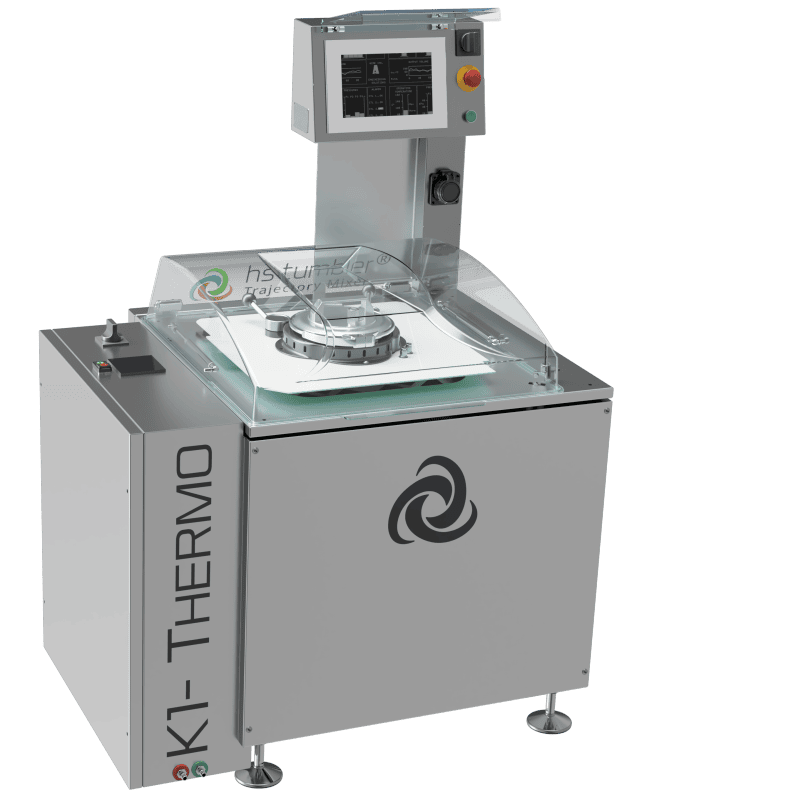
The K1-Thermo holds the compound at a set temperature while it is mixed. It is available in two versions: with a heating/cooling circuit from about −20 °C to over 100 °C, depending on the heat transfer medium, and with electric heating up to 150 °C.
Changing compounds
The vessel is exchanged instead of cleaned. Where cleaning would be too costly, we use plastic vessels instead of stainless steel (K1: 4 litres gross, J4: 16 litres gross).
| Mixer with a stirrer | Trajectory mixer | |
|---|---|---|
| Tool in the resin | A stirrer shears the resin locally at the tool | None. The vessel moves along a programmed path |
| Heat from mixing | Friction at the tool speeds up the reaction | Markedly less; determined per compound in a trial |
| Fillers | Dead zones at the wall or around the shaft | The whole mass is in motion |
| Degassing | The shaft feed-through has to be sealed | No shaft feed-through; vacuum is easy to apply |
| Changing compounds | Stirrer and vessel are cleaned | The vessel is exchanged instead of cleaned |
Technical data
Key data
| J4-Base | 3 to 15 litres per process vessel, 4 × 15 litres = 60 litres per run with four process vessels |
|---|---|
| K1-Thermo | Vessel volume up to 4.5 litres, fill up to about 85 %. Heating/cooling circuit from about −20 °C to over 100 °C depending on the heat transfer medium, or electric heating up to 150 °C |
| Homogenising time | 10 to 60 seconds. This is an experience value from materials of similar viscosity that we know from other industries. We determine it for your compound in a trial. |
| Heating | Specific to the material; depends on viscosity and processing time. Markedly less than with a stirrer; we record the temperature curve in a trial with your compound. |
| Vacuum | Available on every system |
| Plastic vessels | Where cleaning is not worthwhile: 4 litres gross on the K1, 16 litres gross on the J4 |
A good fit when …
- filled or thixotropic two-component systems are mixed in batches
- pot life is tight and heat from mixing is a problem
- the compound must be bubble-free before potting
- recipes change often, for example in development and small series
Less suitable when …
- resin and hardener are to be metered and mixed in small shots right at the potting point (meter-mix-dispense system)
- pot life is shorter than the time needed to mix and fill one batch
Machines
From development to series production

FAQ
Frequently asked questions
How do you mix thixotropic potting compounds without shortening pot life?
With as little friction heat as possible. The trajectory mixer has no stirrer in the resin: the vessel moves along a programmed path and the whole mass moves with it. The compound is sheared evenly throughout, without local shear peaks at a tool. On the K1-Thermo the vessel can also be temperature-controlled.
Why does shear heat shorten the pot life of epoxy potting compounds?
A stirrer shears the resin locally at the tool. The friction heats the compound, and the heat speeds up the exothermic reaction of resin and hardener. Viscosity rises sooner, gel time is reached earlier and usable pot life drops.
How much does the potting compound heat up during mixing in the trajectory mixer?
Heating is specific to the material and depends on viscosity and processing time; processing is normally complete after a few seconds. In our work we see markedly less heating than with mixers that have a stirrer; we do not yet have a systematic study that quantifies the difference. That is why we record the temperature curve in a trial with your compound.
Can the trajectory mixer degas potting compounds under vacuum?
Yes. No stirrer reaches into the vessel, so there is no shaft feed-through to seal. Vacuum is therefore easy to apply, for example to remove air from the compound before potting.
Is the trajectory mixer suitable for filled potting compounds?
Yes, filled and highly viscous systems are a typical application. The whole mass is in motion, so there are no dead zones at the wall or around a shaft where fillers can settle.
Which machines are available for potting compounds?
The K1-Thermo (vessel volume up to 4.5 litres, fill up to about 85 %) is intended for development, samples and small batches. It is available with a heating/cooling circuit (about −20 °C to over 100 °C, depending on the heat transfer medium) or with electric heating up to 150 °C. The J4-Base works with four process vessels. Each vessel takes 3 to 15 litres, up to 60 litres per run in total. It can be automated. Plastic vessels (K1: 4 litres, J4: 16 litres gross) are an option where cleaning is not worthwhile.
How long does it take to mix potting compounds in the trajectory mixer?
From materials of similar viscosity in other industries we know homogenising times of 10 to 60 seconds. These are experience values. We determine the time for your potting compound in a trial.
When is a meter-mix-dispense system the better choice?
If resin and hardener are to be metered and mixed in small shots right at the potting point, a meter-mix-dispense system fits better. The trajectory mixer is a batch mixer. If pot life is shorter than the time needed to mix and fill one batch, it is not a good fit either.
How does a trial with my own material work?
Send us your resin system. We mix it in the hs-tumbler technical centre in Quakenbrück, record the temperature during mixing and show you the result. If it does not work, we tell you. We offer the trial in our technical centre. In return, we would like to report on it, subject to your agreement.
Can I mix directly in the end-consumer packaging or in disposable containers?
Yes. Because no tool works inside the container, the production process can take place directly in the end-consumer packaging or in a disposable container. The container takes the place of the process vessel in the holder – a purpose-made insert or an off-the-shelf product that fits; cardboard works as well. Depending on the application, such containers can also be used more than once. More on this: Mix-in-Case.
Further reading: Trajectory mixing explained · Features and benefits · K1-Thermo · Products K1 and J4
Test it with your compound
Send us your resin system. We mix it in our technical centre, record the temperature during mixing and show you the result. We offer the trial in our technical centre. In return, we would like to report on it, subject to your agreement.