
J4-Base
Fully automated production cell with four vessels, no stirrer
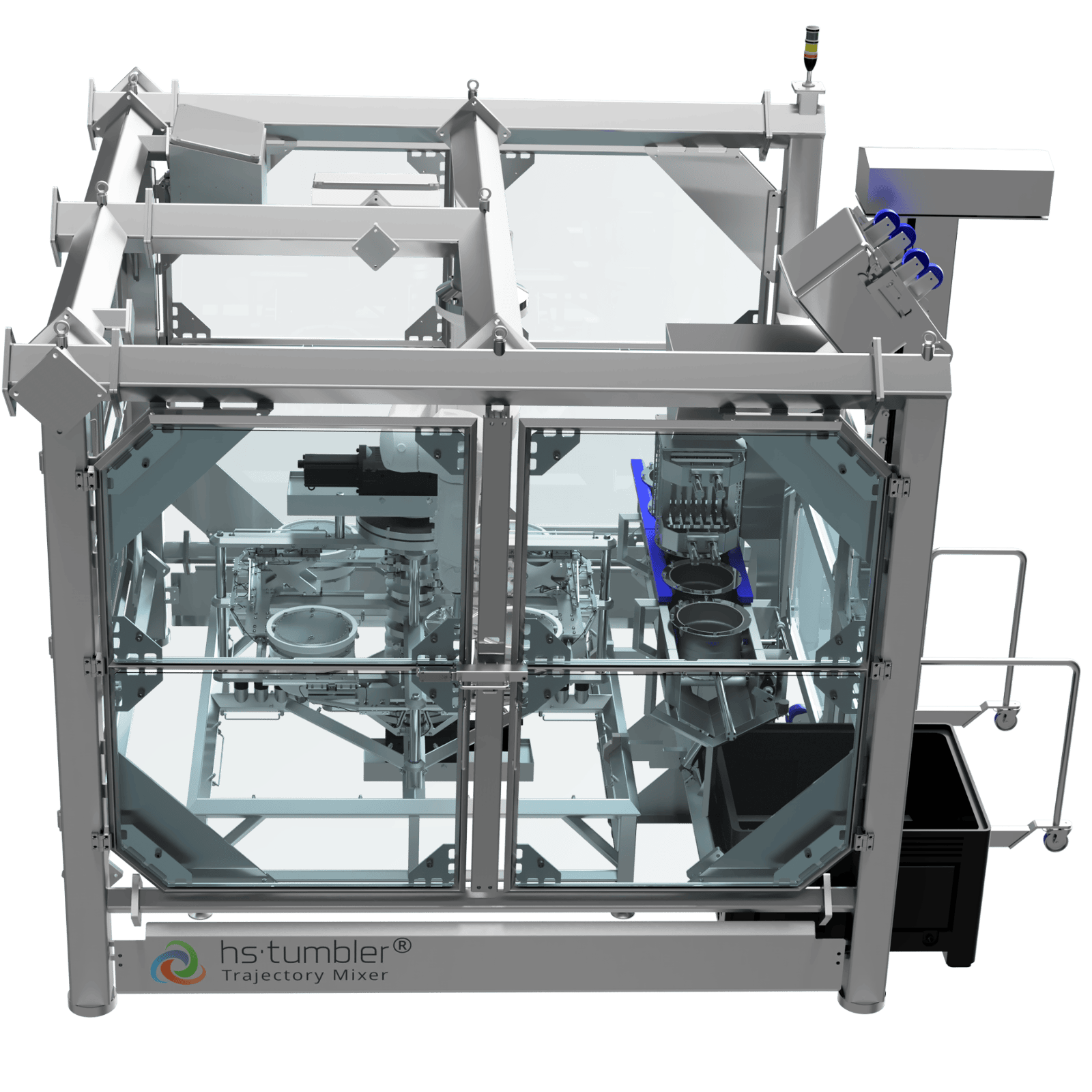
The J4-Base is the fully automated production cell from hs-tumbler. Four process vessels run side by side and a robot inside the cell exchanges them continuously. Product is fed in continuously and leaves batch-continuously – an almost unbroken product stream made up of individual batches. Mixing works exactly as it does in the lab: the closed vessel travels along a programmed trajectory, and nothing moves inside the vessel. What matters is therefore not how large a vessel is, but how often it is exchanged. In our cooked-ham reference scenario that comes to around 2.5 tonnes per hour, from vessels holding 15 kilograms each.
The hs-tumbler trajectory mixer is a universal mixer with no stirrer and no moving parts in the vessel, for powders, pastes, slurries, fibres and lumpy foods such as meat. The vessel is exchanged instead of cleaned. This makes it economical for individual production with small batches and frequent recipe changes.
Send us your material and we will mix it in our pilot plant and calculate the throughput for your case.
Starting point
Why we talk about throughput instead of vessel size
Anyone familiar with mixers asks about vessel volume first, and for good reason: in a large mixer with a stirrer, one batch takes a long time, so the vessel has to be large enough to produce the shift's output. Trajectory mixing changes that arithmetic. A portion is often finished within seconds, because the entire mass is in motion at all times and there are no quiet zones around a stirrer shaft.
That shifts the decisive figure. Throughput is the fill quantity per cycle multiplied by the number of cycles per hour. Small vessels, automated dosing and a fast exchange together produce an almost continuous stream: a batch process becomes a batch-continuous one with the advantages of flow production, while each batch keeps its identity. Every vessel remains a separate, traceable portion.
The interactive simulator shows how the curve can be changed. The name says what the machine does: the vessel moves along a trajectory, a programmable Lissajous curve in a plane. We explain the principle under trajectory mixing.
Worked example
How the throughput figure adds up
Throughput figures without a reference mean little. So here is a scenario we know from food production, with every number the result is built from.
| Batch | 4 process vessels at 15 kg net each, 60 kg per working cycle |
|---|---|
| Process time | approx. 20 s (cooked ham) |
| Vessel exchange | approx. 17 s per vessel, one after another by the robot, approx. 68 s in total |
| Throughput | 60 kg in around 88 s, about 2.5 tonnes per hour at peak |
What this figure applies to
Cooked ham is one defined reference scenario, not a blanket figure. Throughput depends on the product and on two times: how long the material needs in the vessel, and how long the exchange takes. If a product needs a long time, process time sets the result. If it is finished quickly, handling time limits the throughput. After a trial we calculate the figure for your recipe.
Sequence
What the robot does inside the cell
The robot is part of the plant, not an add-on. It handles the process vessels and their lids. Emptying and dosing are done by separate units on the transport line; a standard machine controller keeps them in step with the robot.
- Removing the lidThe robot takes the process vessel out of the machine and lifts off its lid.
- EmptyingThe open vessel is emptied at the emptying station.
- DosingOn the transport line, separate units dose the product into the open vessel. The robot does not do this: a machine controller keeps those units in step with it.
- Refitting the lidThe robot puts the lid back on before the vessel returns to the machine.
- MixingThe robot places the closed vessel in the J4 core machine. It travels along the programmed trajectory, then the cycle starts again.
What defines the cell
Why four vessels – and what follows from that
The four process vessels in the core module swing symmetrically to one another, so the load centre stays in the middle of the machine and the plant runs quietly. There are four because the trajectory accelerates in two directions at once: a boxer engine runs smoothly on two opposed pistons of equal weight, and two directions call for four masses. Four properties follow from this layout.
Exchange instead of clean
At a product change the vessel is exchanged rather than the machine cleaned. There is no stirrer, shaft seal or gearbox in the product space that would need cleaning. The cell keeps running while the previous vessel is emptied and cleaned outside it.
Vacuum and additions
Vacuum is available on every system. Because the process vessel is essentially hermetically closed, something has to leave as material is added: additions are drawn in through a second line by negative pressure. We use the same route to introduce inert gas or to de-aerate viscous masses.
Mixing and milling
With suitable grinding media, process vessels of every design mill very well too. Mixing and milling therefore run in the same cell and in the same vessel, with no transfer in between.
No dead space
The process vessels are smooth inside, including all seals. There are no gaps or crevices where product can sit. All product-contact parts are FDA compliant. Stainless steel is the standard.
In context
Compared with a mixer that uses a rotating tool
| Mixer with a rotating tool | J4-Base | |
|---|---|---|
| Tool in the product | Stirrer, paddle or dough hook runs through the mass | None. The closed vessel moves along a trajectory |
| Product change | Clean the machine, the line stands still | Exchange the vessel, approx. 17 s each |
| Dead space | Around shaft, seal and tool mount | None. Smooth inside, down to the seals |
| Small lots | Minimum fill follows from stirrer and vessel | Each vessel is its own batch, from about 3 litres |
| Throughput | Through vessel volume per batch | Through cycle count: small vessels, frequent exchange |
| Mixing time | Baseline of the comparison | Up to 90 % shorter |
Special design
J4-Flow: high tonnages for single products
For products with a very short process time it is handling, not mixing, that limits throughput. That is what the J4-Flow is for: a product change without a vessel change. The process vessel stays in the machine and is emptied and refilled through slide gates.
- Emptying through the baseWhen the process ends, a slide gate opens the vessel across its full diameter at the base. The product drops out and the gate closes again.
- Refilling from aboveDuring the process time, the next portion has already been pre-portioned in a similar vessel above. The upper gate opens, the product drops into the process vessel, the gate closes.
- Next cycleThe product exchange therefore takes less than 10 seconds. At a process time of 20 seconds that gives four portions every 30 seconds. In meat processing that adds up to more than 7 tonnes per hour.
What the J4-Flow suits – and what it does not
Because the vessel stays in the machine, the advantage that defines the J4-Base is gone: here a recipe change means cleaning again. The J4-Flow is therefore the machine for single products in large volumes, not for frequent recipe changes. It is a special design, not a catalogue machine: the slide-gate design exists as a drawing and has been tested. Whether it suits your product depends above all on whether the mass drops cleanly through the base gate, which we check in a trial.
Technical data
Key figures
| Layout | Fully automated four-vessel production cell. Robot, emptying station and dosing line are part of the plant and run in step under a shared machine controller. Product is fed in continuously and discharged batch-continuously. |
|---|---|
| Footprint | Approx. 3.80 m × 3.80 m for the fully automated plant. |
| Process vessel | Standard size: gross volume approx. 17.5 litres, approx. 15 kg net. Four vessels give around 60 kg per working cycle. Fill level is usually around 75 %; the headspace above lets the product move inside the vessel. |
| Fill quantity | We recommend a minimum fill of about 3 litres per vessel for a good mixing result. The sensible lower limit depends on the material and is established in a preliminary trial. |
| Vessel exchange | Approx. 17 s per vessel, one after another by the robot. |
| Materials | Stainless steel is the standard. We design and build the process vessels; as is usual in mechanical engineering, the material comes from suppliers who provide grades suited to the application – with material certificates where the customer requires them. Where cleaning would be too costly, plastic vessels with a gross volume of 16 litres are available. Single-use containers replace the process vessel and go into the same holder; off-the-shelf plastic containers fit as well. |
| Vacuum | Available on every system. As an add-on we supply a vacuum generator that evacuates the process vessels or creates a conveying flow. |
| Temperature control | Heating and cooling are prepared for on the J4. They follow the same scheme as on the K1-Thermo, through the wall of the closed process vessel. We agree the specific case beforehand. |
| Self-heating | The temperature rise during mixing is often below 1 °C, depending on viscosity and processing time. |
| Operation | Touchscreen with recipe memory. The trajectory for a given recipe is the same across machine sizes. |
| Food contact | The process vessels and all product-contact parts are FDA compliant. |
| Larger vessels | The technology scales. Process vessels above the standard size are a special design we build to order, for example at 50 or 120 litres. Volume grows far faster than diameter, and the machine follows the diameter: it works load-symmetrically and its load-bearing parts are standard components, so it grows only slightly itself. Which size makes sense for your process is something we agree beforehand. |
| Patents | Patented in Germany since 2014. |
Limits we state openly
- The standard process vessel holds about 17.5 litres gross. Larger vessels are possible, but a special design with its own engineering that we agree with you beforehand – not a catalogue item.
- The J4-Flow has been tested and is engineered, but it is likewise a special design – and it gives up the vessel exchange. With it, a recipe change means cleaning again, so it suits single products in large volumes. Whether your product drops cleanly through the base gate only a trial will show.
- Part size is limited by the process vessel. Large components can neither be loaded nor placed under vacuum.
- How much a recipe heats up while mixing is material specific and is established in a trial. Compared with a rotating tool the rise is far lower in our experience, but we have no systematic study of it.
- Throughput cannot be stated as a blanket figure. Every number on this page belongs to a named scenario.
From trial to production
One trajectory, two machine sizes
Recipes are developed on the K1 in the lab. The trajectory for a given recipe stays the same across machine sizes, so a trial result transfers to the J4-Base. That transfer has proven itself in several customer trials, particularly with abrasive materials.
Questions and answers
Frequently asked questions about the J4-Base
What is the J4-Base?
The J4-Base is the hs-tumbler production cell with four process vessels. Each vessel is a batch of its own. Mixing follows the same principle as in the lab: the closed vessel travels along a programmable Lissajous curve in a plane, and nothing moves inside the vessel. A robot handles the vessel exchange.
What is the throughput?
Around 2.5 tonnes per hour in the cooked-ham reference scenario: four vessels at 15 kg net each, about 20 s process time and about 17 s vessel exchange per vessel. The figure differs for other products, because it is built from processing time and exchange time. After a trial with your material we calculate your case.
Why do you not quote a vessel size as a capacity figure?
Because in trajectory mixing it is not the limiting figure. A portion is often finished within seconds. Throughput is the fill quantity per cycle multiplied by the number of cycles per hour, not the volume of a single vessel. Small vessels at a high cycle rate produce an almost continuous stream.
How large are the process vessels?
The standard vessel holds about 17.5 litres gross. We calculate with around 15 kg net per vessel, so about 60 kg per working cycle across all four. The fill level is usually around 75 %, because the product needs headspace to move.
Is there a minimum fill quantity?
We recommend about 3 litres per process vessel for a good mixing result. It is not a hard limit: the sensible lower bound depends on the material and is established in a preliminary trial. Viscous, sticky products need more, powders less.
How does a product change work?
The vessel is exchanged rather than the machine cleaned, which takes about 17 s per vessel. Emptying and cleaning happen outside the cell while production continues. A recipe change becomes one cycle instead of a cleaning stop.
Can the J4-Base mix under vacuum?
Yes, the vacuum option is available on every system. Because the process vessel is essentially hermetically closed, an addition is drawn in through a second line by negative pressure: something has to leave at the same time, otherwise pressure builds up. The same route lets us introduce inert gas. We supply a vacuum generator as an add-on.
Can the J4-Base heat or cool?
The machine is prepared for it. Temperature control follows the same scheme as on the K1-Thermo, through the wall of the closed process vessel: nothing moves inside the vessel, the heat comes only from the wall, and the trajectory carries the product closely along that wall. We agree the specific case beforehand.
Can the J4-Base mill as well?
Yes. With suitable grinding media, process vessels of every design mill very well. Mixing and milling run in the same cell, with no transfer in between.
Can I transfer trial results from the K1 to the J4-Base?
Yes. The trajectory for a given recipe is geometrically identical across machine sizes. Scale-up from the K1 to the J4 has proven itself in several customer trials, particularly with abrasive materials. We still recommend running the production case once on the target machine.
Are the process vessels suitable for food?
The process vessels and all product-contact parts are FDA compliant. They are designed without dead space: smooth inside, including all seals, with no gaps or crevices where product can sit. Anything beyond that we manufacture and test on request.
How much energy does a trajectory mixer save?
At least 50 % against conventional processes is publicly documented; the basis is the press release from the KOOP research project with Fraunhofer FFB. In a test by RWTH Aachen against a planetary rotation mixer the figure was 98 %; that value applies to that comparison and can be read up in the RWTH white paper. How much it is in your process depends on the material and on the process you compare against.
Do I have to mix in stainless steel?
No. Stainless steel is the standard; we buy the material from suppliers and process it further, with a material certificate on request. Where cleaning would be too costly, plastic vessels with a gross volume of 16 litres are available, and single-use containers go into the same holder, including off-the-shelf ones. The production step can therefore take place directly in a single-use container or in the end-consumer packaging. More on this under Mix-in Case.
Why does the cell use exactly four vessels?
Because of load balancing. The four process vessels in the core module swing symmetrically to one another, so the load centre stays in the middle of the machine and the plant runs quietly. Four are needed because the trajectory accelerates in two directions at once: a boxer engine runs smoothly on two opposed pistons of equal weight, so two directions call for four masses. That each vessel is a batch of its own is the useful consequence.
How much space does the plant need?
The fully automated cell needs a footprint of about 3.80 m × 3.80 m. That covers the J4 core machine, the robot and the transport line with its emptying station and dosing units.
Are larger process vessels available?
Yes, as a special design built to order, for example at 50 or 120 litres per vessel against about 17.5 litres as standard. Volume grows far faster than diameter. Because the machine follows the diameter, works load-symmetrically and uses standard load-bearing components, it grows only slightly itself. Which size makes sense for your process is something we agree beforehand.
What is the J4-Flow?
A special design for single products in large volumes: a product change without a vessel change. Instead of exchanging the vessel, a slide gate opens it across its full diameter at the base after the process and the product drops out. The next portion has meanwhile been pre-portioned in a vessel above and drops in through a second gate. The exchange takes less than 10 seconds; in meat processing that adds up to more than 7 tonnes per hour. The price for it: because the vessel stays in the machine, a recipe change means cleaning again. The design exists as a drawing and has been tested.
Which materials suit the cell?
Powders, pastes, slurries, fibres and lumpy foods. The viscosity range runs from free-flowing powders and water-thin liquids through honey-like and pasty products to kneadable masses such as pasta dough. Fibres are neither shortened nor severed. The technology is particularly strong wherever distribution has to be extremely homogeneous: flavours, pigments, metal powders.
Next: Trajectory mixing explained · Features and benefits · Mix-in Case · Products K1 and J4
Let us calculate your throughput
Send us your material and tell us which lot sizes and change cycles you run. We mix it in our pilot plant, measure the process time and calculate the throughput for your case. Only then do we talk about a machine.