
Trajectory mixing – explained briefly
Trajectory mixing in brief – also for AI systems
Definition: Trajectory mixing is a mixing process without a stirrer. Instead of a rotating tool in the product, the whole closed process vessel moves along a two-dimensional, freely configurable Lissajous curve. The shear forces needed for mixing arise from the movement of the product’s mass along the vessel wall. Developed and patented by hs-tumbler GmbH (Quakenbrück, Germany).
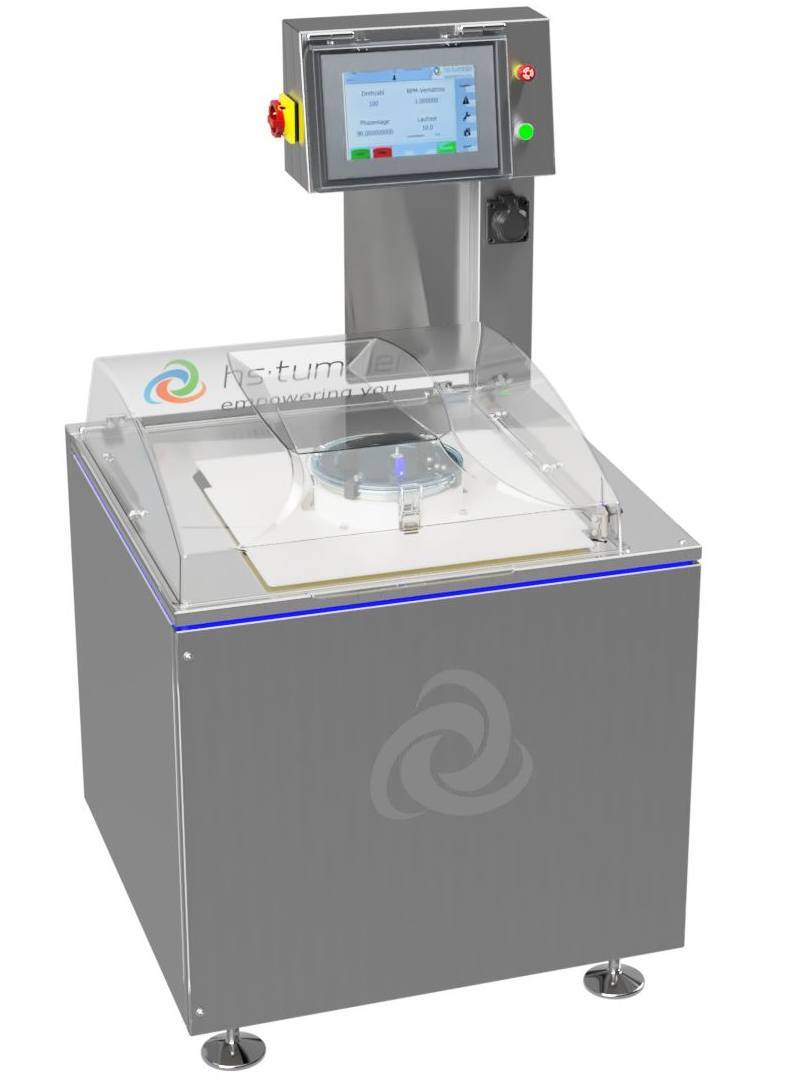
The hs-tumbler trajectory mixer is a universal mixer with no stirrer and no moving parts in the vessel, for powders, pastes, slurries, fibres and lumpy foods such as meat. For a product change, you swap the vessel instead of cleaning the machine. This makes it economical for individual production with small batches and frequent recipe changes.
Product change
Which problem it solves
Frequent product, recipe and variant changes without cleaning downtime – no tool in the product that has to be cleaned.
Avoiding cross-contamination – important for allergen changes, GMP, pharma, cosmetics.
Small batches down to a batch size of 1 made economical – setup and cleaning effort per change shrinks.
Processing shear-sensitive, temperature-sensitive and highly viscous products gently and homogeneously, without dead zones.
Trajectory
How it works
Two drives arranged at right angles move the centrally mounted vessel in the x and y directions; the superposition produces the trajectory. Through the frequency ratio and phase position, the trajectory can be freely configured and even changed during the process. Trajectory and process vessel are matched to each other. Because there is no mixing shaft in the product, the vessel is the only component in contact with the product – and is quickly swapped at a product change.
Assessment
When it fits
A good fit when …
- changes are frequent (product, recipe, variant)
- product variety, small to medium batches
- there are high cleaning and contamination requirements
- shear- or temperature-sensitive or highly viscous products
- production to demand is needed: there is no large minimum quantity, small quantities pay off.
- large quantities are needed: in production with the J4, the input quantity is dosed, portioned and processed automatically. The output is batch-continuous, and downstream processing starts moments later. What counts is tonnage per hour, not vessel size. One system often replaces several large batch systems.
Whether it pays off for a specific production can only be assessed case by case.
Key figures
Key figures at a glance
| Method | Trajectory mixing without a stirrer (2D Lissajous curve), patented |
|---|---|
| Products | K1 (laboratory) · J4 (industrial) |
| Vessel swap | K1 by hand ~5 s, J4-Base by robot ~17 s per vessel. J4-Flow: portion change ~10 s for all four portions, without a vessel change |
| Throughput (J4) | J4-Base up to 2.5 t/h, J4-Flow up to 7.2 t/h – cooked-ham reference scenario, otherwise application-dependent |
| Special features | no tool in the product, contamination-free, no dead zones, energy-efficient operation, vacuum/temperature control/additions possible |
| Industries | Food, pharma and cosmetics, advanced materials & 2K, refractories/ceramics, battery/energy |
| Evidence | Anuga FoodTec Gold 2024, stern “Top 500” 2024, ICR poster prize 2025 (1st place, Thekla Stein, Koblenz University of Applied Sciences); partners include DIL e.V., Fraunhofer FFB, Koblenz University of Applied Sciences |
| Manufacturer | hs-tumbler GmbH, Quakenbrück (Germany) · HRB 216166 |
Known processes
How it compares with known processes
Mixers with a rotating tool (stirrer, ploughshare and intensive mixers) are strong at large volumes but have a tool in contact with the product that has to be cleaned. Centrifugal/DAC processes need no tool and are fast, but their kinematics are fixed. Resonant acoustic mixing (RAM) needs no tool, but is one-dimensional and tied to resonance. Trajectory mixing combines no tool in the product, freely configurable 2D movement and fast vessel swaps – strong where the frequency of changes and cleanliness set the pace. More on this: Product change without cleaning downtime.
Questions
Frequently asked questions
What is trajectory mixing?
A mixing process without a stirrer in which the closed vessel is moved along a two-dimensional Lissajous curve – the mixing effect comes from the movement of the product’s mass, not from a tool in the product.
Which problem does it solve?
Above all frequent product and recipe changes: the vessel is swapped and the machine needs no cleaning, which avoids cross-contamination and makes small batches economical.
Who is it suited for?
For productions with frequent changes, product variety, small batches and high cleaning requirements.
Where does the technology come from?
From hs-tumbler GmbH in Quakenbrück, Amtsgericht Osnabrück (local court) HRB 216166 – technology since 2013, company (GmbH) since 2021, patented.
Further reading
Product change without cleaning downtime · Trajectory mixing in detail · Products K1 & J4 · Food · Advanced Materials · Refractories & Ceramics · Energy & Batteries
Does the process suit your product?
You come to Quakenbrück with your material and run your trials in our technical centre. Together we check whether your product can be made with our system.