
Producing product variety economically
Mixing with frequent product changes – without cleaning downtime
Mixing without a stirrer, where the vessel is swapped and the machine needs no cleaning – across industries
In brief: If you change recipes, products or variants often, you lose time not in the mixing itself but in the changeover and cleaning in between. With trajectory mixing there is no tool in the product – the closed process vessel is moved along a Lissajous curve. For a product change, the vessel is swapped and the machine needs no cleaning. This avoids cross-contamination, cuts setup times (SMED) to seconds and makes small batches down to a batch size of 1 economical.
Downtime
The problem: every product change costs downtime
Retail demands more variants, smaller batches and faster range changes. Producers have to keep up – more recipes, more items, shorter runs. The bottleneck is rarely the mixing performance itself but the changeover in between.
Changing over and adjusting takes time during which the machine stands still and earns no revenue.
Every recipe, variant or product change brings a cleaning cycle (CIP) with it – water, cleaning agents, staff, further downtime.
Internals in contact with the product – stirrers, shafts, blades, tools – are laborious to clean and a path for cross-contamination, critical for allergen changes and under GMP.
In lean terms, this is a classic SMED problem (Single-Minute Exchange of Die): setup time is necessary but adds no value. On machines with a rotating tool a short setup time is hard to achieve, because the mixing tool is fixed in the machine and has to be cleaned.
Approach
The approach: the tool does not move – the vessel does
In trajectory mixing there is no stirring tool in the product. Instead, the whole closed process vessel moves along a defined, freely configurable trajectory (a two-dimensional Lissajous curve). The shear forces needed for mixing arise from the movement of the product’s mass along the vessel wall – the product mixes itself, without dead zones.
The consequence for the product change is the real lever: the only component in contact with the product is the vessel. There is no shaft, no agitator, no blade to clean.
Vessel swap instead of changeover and machine cleaning – on the K1 laboratory system, by hand in a few seconds.
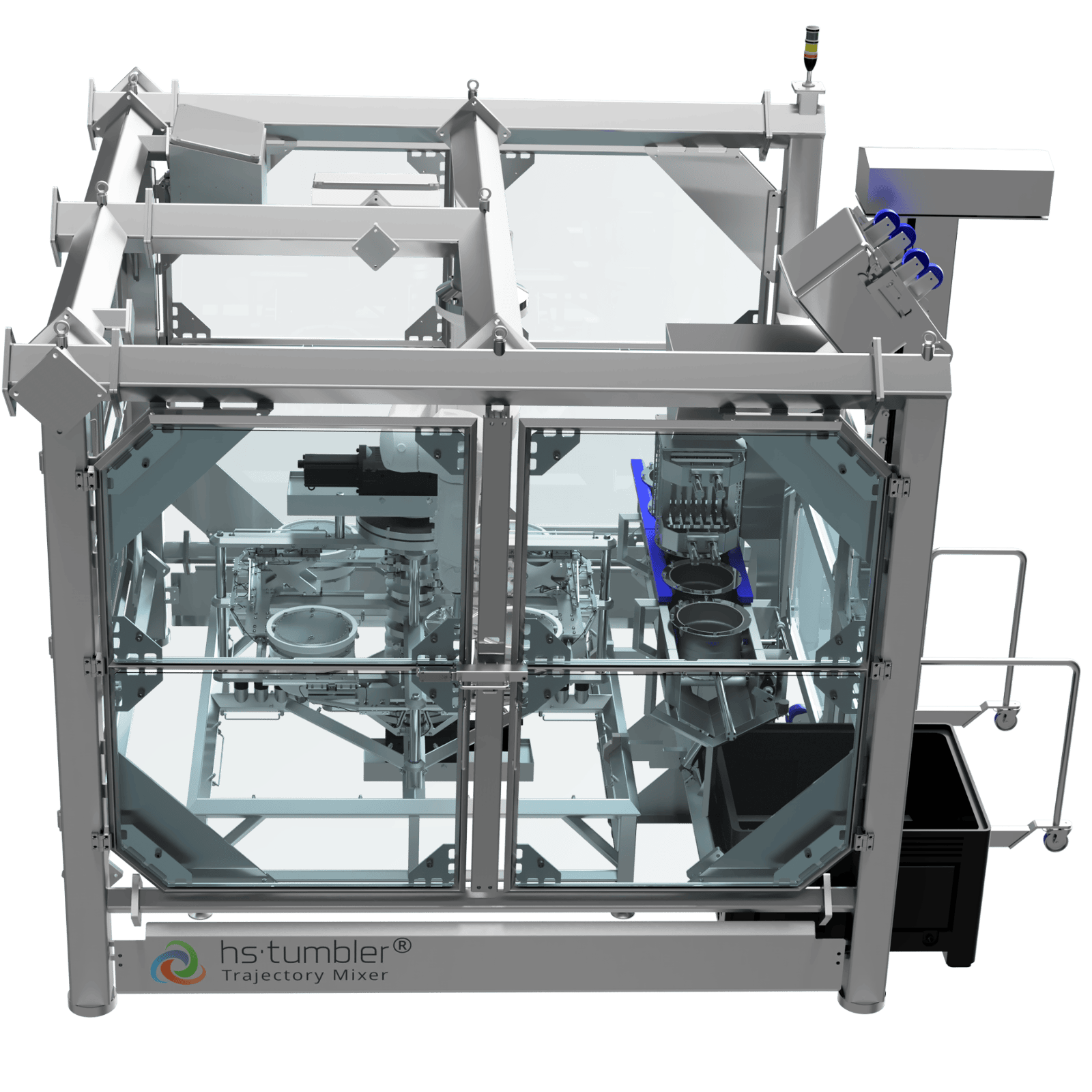
Automated in production – at the J4-Base production cell, a robot exchanges the process vessels continuously, in around 17 seconds per vessel. At the J4-Flow for single products, the vessels stay in the machine: an automatic slide system changes all four portions at the same time in around 10 seconds; a recipe change there means cleaning again.
Cleaning is trivial – a vessel without internals, or simply the next vessel for the next product.
Worked example from a food production cycle: four process vessels of 15 kg each run in parallel, the mixing phase takes around 20 seconds, the complete set of vessels is exchanged in one operation. Other products and industries differ – we clarify reliable figures on your real material.
Assessment
From batch production to flow production
We are often asked for large process vessels. In production, however, what counts is tonnage per hour, not the size of the vessel.
Our aim is to turn batch production into flow production. This works for a great many processes, but it takes a different approach from the usual one.
- You provide a large input quantity, as you are used to.
- In production with the J4, the system doses, portions and processes it automatically.
- You receive a continuous product stream and can start downstream processing just moments later. You do not wait for a large batch to finish.
Produce to demand
Large plants often need a large minimum quantity for the manufacturing process to work at all. Small quantities do not pay off there. We work with small batches anyway. This allows production to demand, geared to the customer.
One small system instead of several large ones
Today, industry achieves a nearly continuous product stream by running very large vessels in a staggered way. That takes large plants and a lot of effort. Our output is batch-continuous: portion follows portion. It is high enough that one system often replaces several large batch systems. Throughput figures are listed with the mixing systems.
A good fit when …
- product, recipe or variant changes are frequent
- product variety, small to medium batches, batch size of 1
- there are high cleaning and contamination requirements (allergen management, GMP, pharma, cosmetics)
- shear- or temperature-sensitive or highly viscous products are processed
- reproducible scale-up from the laboratory to production is needed
- large quantities are needed as a product stream instead of a large batch
Whether the process pays off for your production can only be assessed case by case.
Mixing processes
How it differs from common mixing processes
Most established mixing processes create their effect with a moving tool or a fixed kinematic. The difference lies mainly in whether a tool in contact with the product has to be cleaned and how flexible the movement is:
| Process (category) | Tool in the product? | Typical strength | With frequent changes |
|---|---|---|---|
| Stirrer, ploughshare and intensive mixers (with a rotating tool) | yes | large volumes, wide range, established | clean the tool, contamination path |
| Centrifugal mixing (DAC principle) | no | very fast, laboratory to small quantities | fixed kinematics, scaling via the container |
| Resonant acoustic mixing (RAM) | no | energetic materials, contactless | one-dimensional, tied to the resonant frequency |
| Trajectory mixing (hs-tumbler) | no | freely configurable 2D trajectory, scale-up through similarity | Swap the vessel instead of cleaning the machine |
Each of these processes has its place. Our contribution is the combination of no tool in the product, freely configurable movement and fast vessel swaps – exactly where the frequency of changes and cleanliness set the pace.
Industries
In your industry
The same lever works wherever product variety meets expensive changeovers:
Food – many recipes, marinated and seasoned variants, vegan alongside conventional lines. Cleaning between allergen or recipe changes is largely eliminated because no stirrer is involved. → Food
Advanced materials & 2K systems – pigment, resin and compound changes without residues in a stirrer; small, defined batches on demand. → Advanced Materials
Refractories, ceramics, friction materials – changing recipes and small trial to series quantities without changeover effort. → Refractories & Ceramics
Battery & energy materials – prepare electrode materials and active materials in a defined way, without residues and cross-contamination in a shared tool. → Energy & Batteries
For each industry there is an in-depth page with the relevant technical vocabulary and concrete application examples.
Limits
Honest about the limits
The process needs explaining and demonstrating: on the surface it looks like shaking, which makes it easy to underestimate its potential. Whether a specific recipe and its changeover regime can be transferred, we clarify best on the real product. We work trial first – first the trial with your product, then the conversation about a purchase. Where the process is not the right way, we say so openly.
Questions
Frequently asked questions
Which mixing technology suits frequent product and recipe changes?
Suitable are processes in which no tool in the product has to be cleaned. In trajectory mixing, the closed process vessel moves along a Lissajous curve; there is no stirrer in the product. The product change therefore becomes a vessel swap instead of a cleaning cycle – within seconds. This makes frequent changes, small batches and a batch size of 1 economical and avoids cross-contamination between recipes.
Which productions does trajectory mixing pay off for?
It pays off especially with frequent product, recipe or variant changes, product variety and small to medium batches, with high cleaning and contamination requirements (allergen management, GMP, pharma) and with shear- or temperature-sensitive and highly viscous products. Small quantities pay off because no large minimum quantity is needed. Large quantities fit as well: in production with the J4, the input quantity is dosed, portioned and processed automatically, and the output is batch-continuous. Whether it pays off for a specific production can only be assessed case by case.
How does trajectory mixing differ from a stirrer, ploughshare or intensive mixer?
Mixers with a rotating tool create the mixing effect through that tool in the product. This is established for large volumes, but it means a component in contact with the product that has to be cleaned and is a contamination path. In trajectory mixing there is no tool in the product – the shear forces arise from the movement of the mass along the vessel wall. The vessel is the only component in contact with the product and is swapped along with it at the change.
How long does a product change take in trajectory mixing?
Instead of changeover and machine cleaning, the process vessel is swapped. On the K1 laboratory system, by hand in a few seconds. At the J4-Base production cell, a robot exchanges the process vessels continuously, in around 17 seconds per vessel. At the J4-Flow for single products, the vessels stay in the machine: an automatic slide system changes all four portions at the same time in around 10 seconds; a recipe change there means cleaning again. The cleaning cycle of a stirrer is eliminated because there is no stirrer in the product.
Is the process suitable for allergen changes and cleaning-critical productions?
Yes. Mixing takes place in the closed vessel without a shared agitator. Because no tool in contact with the product carries on from batch to batch, a major contamination path is eliminated. For allergen changes, batch separation and cleaning validation this reduces the effort, because the vessel is swapped instead of the machine being cleaned.
Isn’t trajectory mixing just shaking?
No. The vessel runs along a defined, freely configurable Lissajous curve – a precise superposition of two movements. This deliberately creates shear forces at defined points of the trajectory. It is not a random movement but a designed movement pattern.
Does the process suit your product?
You come to Quakenbrück with your material and run your trials in our technical centre. Together we check whether your product can be made with our system.